Mirror fashion video: reflections and adult styling
Plan a mirror fashion video with authorized adult outfit references, coherent reflections and stable faces, using simple poses and careful frame checks.
5 seconds · 480p · $3.99. Pay per video, no subscription required.
Updated
AI-generated editorial illustration: an adult fashion look in red city light. This is a styling reference, not a video-generation result.
Treat the reflection as part of the same person
Mirror fashion photography creates a demanding AI video brief because the viewer may see the adult directly and in reflection at the same time. Those views must belong to one person, one outfit and one movement. Start with an authorized image of a consenting adult in a complete fashion look. Decide whether the mirror shows the face, the back of the outfit or only a partial silhouette. The reflection is not a second character reference. A visually attractive frame can still fail if the reflected adult turns at a different time or wears a different collar. Plan a small action so these relationships remain possible to inspect.
Choose a reference with understandable geometry
A flat mirror with visible edges is easier to interpret than several angled mirrors or a curved reflective wall. Look at where the camera, subject and mirror appear to be. The reflection should show a plausible view from that arrangement. If the source is already a composite with impossible geometry, animating it may amplify the inconsistency. Keep enough of the mirror frame visible to establish the surface without making it dominate the outfit. A clean background also helps: reflected furniture and doors add many extra relationships to maintain. Avoid a source where the mirror edge passes through the face or the hand is partly hidden behind a phone unless that overlap is essential.
Decide whether the direct or reflected view leads
A fashion portrait can prioritize the direct face and use the reflection to show the back of a jacket. Alternatively, the reflection can be the main portrait while the real shoulder remains a foreground shape. State that hierarchy in the shot brief. Giving both views equal visual weight makes every mismatch more obvious, which may be useful for a deliberate two view editorial but increases review work. The fashion video guide helps define the clothing priority. Choose one feature the reflection adds, such as the coat’s back seam, instead of including a mirror simply as decoration with no role in the composition.
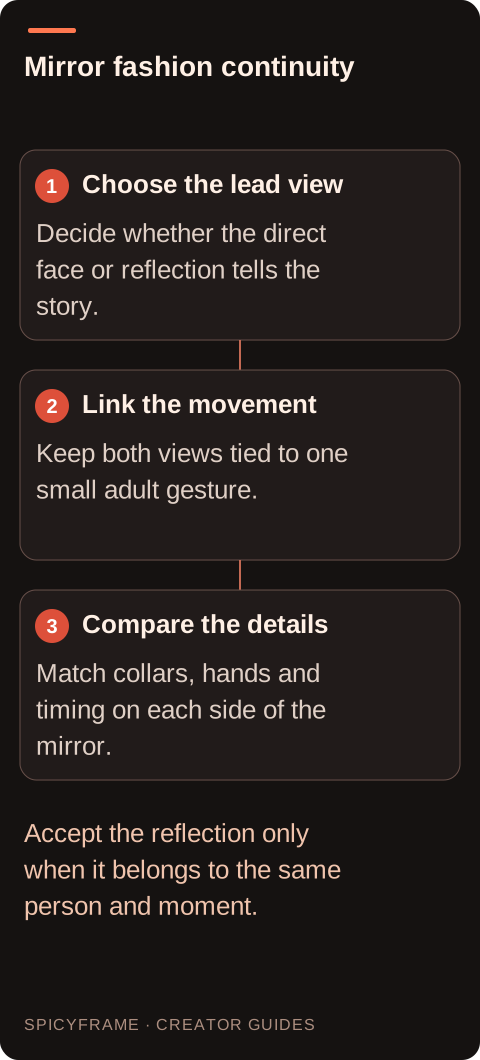
Choose the lead view: Decide whether the direct face or reflection tells the story.. Link the movement: Keep both views tied to one small adult gesture.. Compare the details: Match collars, hands and timing on each side of the mirror.. Accept the reflection only when it belongs to the same person and moment.
Keep movement small and physically linked
A slight head turn, relaxed change of posture or gentle camera push is a more focused first test than a full rotation. The direct body and reflection should move together, with the reflected direction consistent with the mirror view. Watch hands and accessories because a small mismatch is easy to spot near a reflective surface. Do not ask the reflected person to smile while the direct person remains neutral unless the scene is clearly a fictional surreal concept. The camera movement guide explains why a restrained viewpoint can reduce newly exposed geometry. Prompting can express the relationship, but it cannot lock reflection timing with a dedicated control.
Write a brief that names the mirror’s purpose
A proposed prompt might say: “Use @Image1 for the consenting adult in the green blazer beside the flat mirror. The direct face is the main portrait; the mirror shows the same adult’s jacket from the side. One small head turn, relaxed standing pose, steady soft window light, camera nearly still, quiet room ambience.” This is a planning example, not a tested recipe. @Image1 identifies the source, without guaranteeing the reflected identity or wardrobe. Avoid phrases that accidentally imply a second adult in the mirror. If the reflected face changes, reduce the action or choose a composition where only the back of the outfit is visible in reflection.
A hypothetical boutique fitting portrait
Suppose a boutique has permission to animate an adult model wearing a cream coat beside one full length mirror. The approved concept is a five second editorial portrait showing the coat’s front directly and its side in reflection. The review sheet records the belt knot, collar shape and subject’s hairstyle. A reviewer watches the direct and reflected shoulders together as the person makes a small turn. If the reflection moves first or shows an extra belt, the clip fails the agreed continuity check. A new attempt should simplify the pose or reflection crop. This hypothetical process does not imply any measured success rate or a guarantee that a mirror shot will render correctly.
Inspect reflections beyond the face
Check the mirror frame for bending, the floor line for discontinuities and the reflected background for objects that appear or vanish. A reflection can look stable at the center while drifting near the edge. Compare jewelry, phone shape and sleeve length across both views. The identity guide helps with facial review, while the artifact guide covers warped objects. Review at normal speed first, then pause around the turn. If the shot requires exact reflections of a real product or room, generation may not meet that need. Consider conventional photography or a carefully controlled external composite instead of presenting invented geometry as factual.
Finish the mirror portrait without hiding the problem
SpicyFrame exports vertical 9:16 MP4 with ambient audio, using 5, 10 or 30 second durations. A short test can reveal whether the mirror relationship holds. More pixels at High 720p or Ultra 1080p will not fix contradictory movement. Cropping or trimming in an external editor may remove an unneeded problematic edge, but avoid cutting away the very feature the brief promised to show. Keep the adult’s permission scope aligned with the final editorial context and captions. A mirror scene should read as an authorized fashion portrait, with any AI treatment described honestly where it could otherwise be mistaken for an ordinary recorded fitting or documentary view.
Mirror fashion video: planning decisions
Choice
Use when
Acceptance check
Direct face leads
The reflection mainly explains the garment
Both views retain the same adult and outfit
Reflection leads
A foreground shoulder frames the mirror portrait
The reflected face remains stable and recognizable
Single flat mirror
Clear geometry matters to the brief
Frame edges and background lines remain straight
Small head turn
The reflection must track one simple action
Both views move together with plausible direction
External trim
A useful stable moment exists inside the clip
The selected segment still fulfills the shot purpose
AI image-to-video questions answered
Is the reflection a second character?
No. In a normal mirror fashion scene, it is another view of the same adult. Name that relationship clearly and inspect identity, wardrobe and movement in both views rather than supplying conflicting character descriptions.
Why does the reflected face look different?
The generation may interpret the reflection as a separate person or reconstruct a weakly visible face. Use a clearer source, reduce movement or choose a composition where the mirror shows an outfit detail rather than a second close facial view.
Are several mirrors harder than one?
They create more views and geometric relationships to inspect. Start with one clearly bounded flat mirror if reflection consistency is important. Multiple mirrors may suit an abstract concept, but each extra reflection can introduce another identity or timing mismatch.
Can I hide a reflection problem with a crop?
Only if the crop still meets the agreed shot purpose and preserves useful framing. External cropping is a finishing choice, not proof that the original reflection was accurate. Keep a record of what the final composition actually shows.
Should the subject hold a phone?
Only when a mirror selfie is part of the approved concept. A phone adds a prop, hand overlap and possible face obstruction. Check its shape and position carefully, and do not describe the image as covert or captured without the adult’s knowledge.
Does a higher resolution improve mirror geometry?
It adds pixels rather than geometric guarantees. A sharp reflection can still contradict the direct view. Judge linked movement and matching outfit features before choosing the final resolution for the accepted clip.