What happens when a piment-paid generation is confirmed failed?
The deducted piments are restored under the confirmed-failure policy. Check the order and wallet record; this restoration is different from a refund to a bank card.
SPICYFRAME · PRACTICAL GUIDES
Understand refunds for non-explicit adult glamour video by distinguishing confirmed failures, delayed requests, completed results and payment review.
5 seconds · 480p · $3.99. Pay per video, no subscription required.
Updated

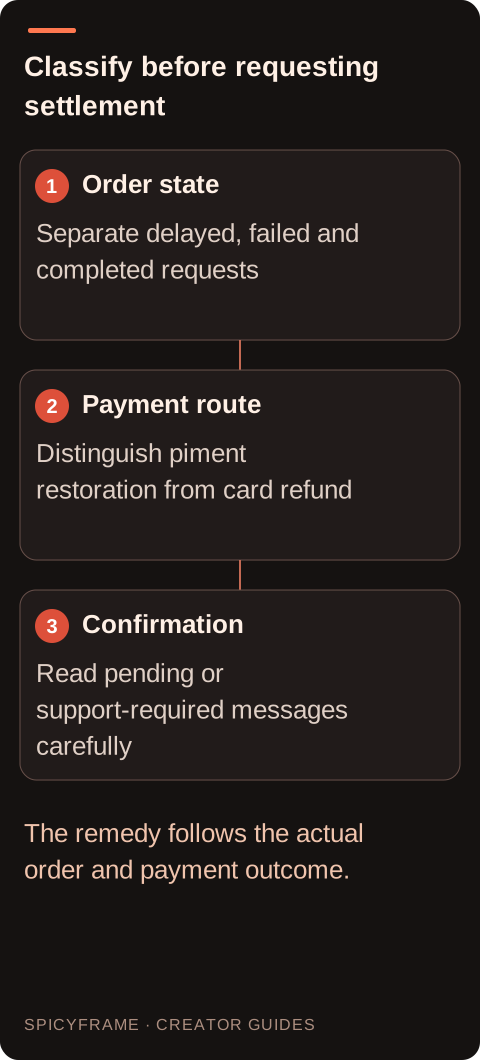
NSFW-style AI video refunds depend on the actual generation and payment outcome, not simply whether a non-explicit adult glamour clip matches your taste. A confirmed generation failure is different from a request still being checked, a completed file with unwanted motion or a payment whose status is unclear. Start with the existing order page and receipt. Do not open a second checkout merely because a render takes longer than expected. A hypothetical fashion portrait might produce a technically completed video whose jacket movement is too dramatic; that creative disappointment is not automatically a confirmed failure. Conversely, an order that never delivers because the provider confirms failure follows the applicable restoration or refund path. Correct classification prevents unnecessary repeat payments and makes support evidence more useful.
For a confirmed failed render paid with piments, the studio restores the deducted piments. For a confirmed failure on a single-video card payment, the current implementation requests a Stripe refund. These are different settlement routes tied to how the generation was purchased. The reviewed code also tracks refund confirmation rather than treating every request as immediately completed. The pay-as-you-go guide explains the one-off purchase model, while the payment terms describe the broader framework. Do not assume that a credit restoration appears as a bank refund or that a card refund becomes a wallet balance. Check the actual order message and relevant wallet or payment record before concluding that settlement is missing.
Generation time varies, and an uncertain provider response can require review to avoid submitting or charging twice. The current implementation includes messages asking users not to pay again while the existing request is checked. A delayed status is therefore not proof that the order failed, nor proof that a second purchase is necessary. Keep the order reference and return through the normal status flow. The generation-time guide provides useful context without promising a completion deadline. If the status remains unclear, contact support with the existing reference rather than generating a chain of duplicate requests. A clean timeline of checkout, payment confirmation and status messages helps distinguish a delivery problem from a payment reconciliation issue.
AI animation can change a face, garment edge, hand or background even when the prompt asks for stability. A completed video that looks awkward or differs from the intended style is not automatically a confirmed generation failure under the stated policy. Review a short draft before buying a longer or higher-resolution version, particularly for a real adult fashion portrait whose likeness and clothing matter. The artifact guide can help decide whether simplifying motion or improving the reference is a sensible next step. Do not publish an inaccurate or unapproved result merely because it was paid for. The creative decision to reject it and the financial classification of the order are separate questions, and mandatory consumer rights are not waived by this distinction.
The reviewed implementation distinguishes a successful refund from a request awaiting processor confirmation and from a refund blocked by payment permissions. If the order says that a refund is pending or support must resolve the payment, keep that message and the receipt. Do not assume the refund is complete merely because it has been requested. Likewise, do not assume the absence of an immediate bank update means the studio issued a new charge. This guide does not promise a fixed bank posting time. Ask support to clarify the recorded settlement status using the order reference. Avoid sending full card numbers or security codes; a limited receipt identifier and concise description are normally more appropriate evidence for a transaction review.
Deleting media removes creative assets under the relevant controls; it is not a refund request. Cancelling a weekly subscription stops future renewal according to the billing flow; it does not automatically reverse every earlier completed generation. Account deletion has broader effects, but the terms explicitly distinguish deletion from withdrawal and preserve applicable statutory rights. If you want a payment reviewed, state that goal clearly through the support route before discarding information needed to identify the order. The privacy guide explains necessary records and storage boundaries. Keep your own receipt and relevant status evidence without retaining another adult's source image beyond the agreed scope. Financial support usually needs the transaction reference, not a collection of sensitive draft portraits.
Include the order identifier, purchase method, selected duration and quality, payment date and the exact status message. Explain whether no file was delivered, the file cannot be opened or the completed motion is simply unsuitable for the brief. Those are different issues and should not be collapsed into “it failed.” If a screenshot is needed, crop out unrelated account or financial information. Do not claim that a disliked result was never delivered when it was. Honest evidence helps support apply the correct policy and investigate a genuine technical issue. A hypothetical five second Medium draft costs $3.99; recording its specific order is more useful than reporting a general weekly spend without identifying which request needs attention.
Plan a limited number of creative attempts and define what each one is testing, such as jacket stability or a face turn. SpicyFrame offers 5, 10 or 30 second vertical MP4 clips with ambient audio; exact captions and timeline editing happen externally. A five second draft can reveal a problem before an expensive longer render, but it does not guarantee the next version. The duration guide helps match the purchase to a concrete visual question. Do not budget on the assumption that every rejected creative option will be refunded. Use confirmed-failure settlement for the failures it covers, preserve any applicable legal remedies, and decide separately whether another generation is worth its displayed price.
| Decision | Practical action | Approval evidence |
|---|---|---|
| Confirmed piment failure | Check restoration in the wallet | Order and balance reflect the settlement |
| Confirmed card failure | Read the refund status message | Requested and completed refunds are distinguished |
| Delayed request | Follow the existing order | No unnecessary second payment |
| Completed result | Separate creative review from failure policy | Issue is described accurately |
| Support evidence | Use order references and limited screenshots | Sensitive financial details are excluded |
The deducted piments are restored under the confirmed-failure policy. Check the order and wallet record; this restoration is different from a refund to a bank card.
The implementation requests a Stripe refund and tracks its status. A requested refund may still need confirmation or support resolution, so read the actual order message rather than assuming immediate completion.
A delay or uncertain provider response is not by itself a confirmed failure. Follow the existing order status and support process, and avoid paying again while that request is being checked.
A completed result you dislike is not automatically classified as a generation failure. Review the stated policy and any applicable consumer rights, and distinguish creative dissatisfaction from a genuine delivery or technical issue.
No. Deletion and payment remedies are separate matters. State the payment issue through the appropriate support route and retain the necessary transaction references before removing account or media access.
Provide the order or receipt reference, purchase method and exact status or delivery problem. Avoid full card details and unrelated screenshots, and describe honestly whether the file was absent, unusable or creatively unsuitable.
External pages, opened in a new tab. Rankings reflect the time of writing.