How much video value does one piment represent?
At the studio's stated conversion, 100 piments equal $1 of video value, so one piment corresponds to one cent of listed generation value. Credits are not transferable cash or a withdrawal balance.
SPICYFRAME · PRACTICAL GUIDES
Check piment costs for non-explicit adult glamour video, compare duration and quality, budget retries and distinguish wallet value from finished output.
5 seconds · 480p · $3.99. Pay per video, no subscription required.
Updated

NSFW-style AI credits are easiest to understand when a non-explicit adult glamour project has a defined deliverable. A render is one generated file; a finished clip is a reviewed asset that fits the brief and has any necessary external editing. A hypothetical fashion portrait may require one short test and one final generation, or the first completed result may be good enough. Do not assume every paid attempt becomes usable work. Write the approval criteria before spending: stable adult likeness, unchanged garment coverage, correct accessory details and a clear camera move. That definition lets you calculate the actual cost per approved clip after production, rather than using the cheapest advertised render as if it guaranteed a finished campaign asset.
The studio uses 100 piments as $1 of video value. A 399-piment generation therefore corresponds to a $3.99 listed video price, and a 2,499-piment generation corresponds to $24.99. Piments are internal credits, not cash that can be transferred or withdrawn. Keep wallet value separate from the amount you paid to acquire it, because optional weekly plans provide an allowance at a different effective acquisition cost. The pay-as-you-go guide explains the direct purchase alternative. For planning, first calculate the required piments from the selected renders, then compare that demand with the actual wallet and purchase route. Do not mix dollars and credit units in the same total without showing the conversion.
Medium 480p costs 399 piments for 5 seconds, 499 for 10 seconds and 1,199 for 30 seconds. High 720p costs 499, 899 and 2,499 piments for those durations. Ultra 1080p costs 1,199, 2,399 and 7,099 piments. These correspond to $3.99/$4.99/$11.99, $4.99/$8.99/$24.99 and $11.99/$23.99/$70.99 respectively. Check the displayed quote before confirming a generation. Resolution changes the output size, not the guarantee of accurate faces, logos or clothing. The resolution guide offers background on choosing a draft size, while the current studio includes Ultra 1080p as well. There is no 4K output in the stated options.
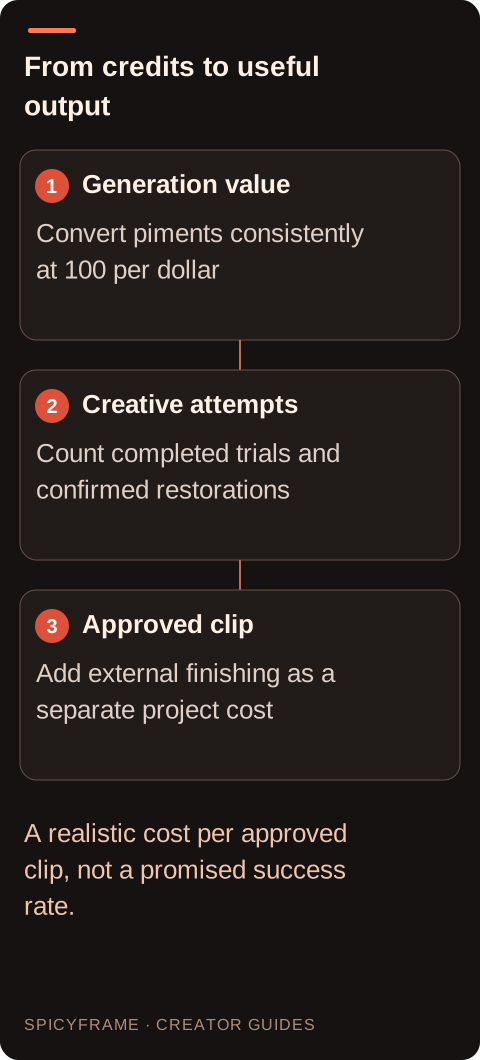
Suppose an authorized adult portrait needs two five second Medium studies to compare a locked camera with a slow forward move, followed by one five second High generation. The planned cost is 399 plus 399 plus 499, or 1,297 piments, equivalent to $12.97 of listed video value. If only the final clip is approved, that is the generation value spent per approved clip in this hypothetical sequence. It is not a tested success rate or a promise that three attempts will suffice. If the first study already meets the need, the creator may stop there instead of buying the planned final. Make each purchase conditional on what the previous review actually learned, rather than treating a budget as an instruction to spend all of it.
Identify the detail most likely to fail before choosing a trial. A small face turn may challenge identity consistency; a jacket adjustment may change seams or coverage; a complex background may distract from the garment. Test one uncertainty at a time and record why a completed result was accepted or rejected. The artifact guide helps distinguish problems that might respond to simpler motion from details that need a better source image. Do not buy a larger resolution merely because a lower-resolution result was anatomically wrong. An Ultra render may reproduce the same conceptual error more sharply. A completed creative rejection is not automatically refunded, so a retry allowance should be a deliberate spending limit rather than an open-ended expectation of eventual perfection.
Confirmed provider failures restore piments through the applicable order settlement. That differs from choosing not to use a completed clip. Track the original deduction and any restoration against the same order so you do not count a failed render twice in the production total. An unresolved or delayed request should remain separate until its outcome is confirmed; do not assume restoration has happened or pay again merely because the status is slow. The generation-time guide explains why processing can vary. If the balance appears inconsistent, retain the order reference and ask support to review the specific transaction. A clean ledger of purchases, deductions and restorations is more informative than estimating cost from memory after several drafts.
SpicyFrame generates vertical 9:16 MP4 clips with ambient audio, but accurate captions, logos, music replacement, sequence assembly and publication require external tools. Those tasks may involve paid software, licensed assets or human editing time. Keep them in a separate production column so the piment calculation remains clear. A hypothetical campaign with a cheap successful render can still require substantial time to obtain model approval and prepare different crops. Conversely, a simple approved portrait may need very little finishing. Credits measure studio generation value, not the entire effort of a compliant commercial asset. Review source-image rights and the consenting adult's distribution scope before spending, because a technically usable clip has little practical value if its intended use was never authorized.
Optional weekly plans currently list 1,249 piments for $9.99, 2,499 for $19.99 and 4,999 for $39.99 per week. Their value depends on actual recurring demand and the cash commitment, not simply on receiving more credits. Unused piments carry over under the current terms, but a growing balance is not the same as money saved on work you needed. For occasional clips, guest pay per clip may be a better fit. The duration guide can help avoid unnecessary length, while a simple project ledger reveals the actual average cost of approved results. Report that average only from your own completed work with its sample size and context; do not invent customer success rates or generalize a hypothetical budget into a performance claim.
| Decision | Practical action | Approval evidence |
|---|---|---|
| Medium 480p | 399 / 499 / 1,199 piments for 5 / 10 / 30 seconds | Use a suitable draft to test one uncertainty |
| High 720p | 499 / 899 / 2,499 piments for 5 / 10 / 30 seconds | Inspect content before increasing detail |
| Ultra 1080p | 1,199 / 2,399 / 7,099 piments for 5 / 10 / 30 seconds | Resolution does not guarantee correctness |
| Hypothetical workflow | 399 + 399 + 499 = 1,297 piments | One approved clip is not guaranteed |
| Actual project total | Track deductions, restorations and approved outputs | Keep external editing costs separate |
At the studio's stated conversion, 100 piments equal $1 of video value, so one piment corresponds to one cent of listed generation value. Credits are not transferable cash or a withdrawal balance.
It costs 499 piments, corresponding to the listed $4.99 video price. Confirm the quote before generating and budget separately for any completed creative retries or external editing.
Add the actual planned trials and final generation, then allow a deliberate limit for uncertainty. A finished clip may require several completed renders, so the cheapest single-render price is not a guaranteed project total.
No such guarantee exists. Resolution does not reliably correct identity drift, garment changes or a poorly specified camera move. Test the relevant visual problem before purchasing a larger output.
Track their deductions and subsequent restorations separately. Once piments are restored for a confirmed failure, account for that settlement accurately rather than counting both the original charge and the restored value as spent.
Not necessarily in actual cash terms. A recurring plan can leave unused value while continuing to renew. Compare realistic demand, carryover and renewal cost with the available guest pay-per-clip alternative.