Why is lace difficult to preserve in motion?
It contains many small repeated shapes that can change or crawl across frames. Use stable landmarks such as borders and motifs to review continuity rather than judging overall detail alone.
SPICYFRAME · PRACTICAL GUIDES
Plan adult lace-fashion videos with opaque lining, readable motifs, restrained movement and careful checks for pattern drift, edges and garment detail.
5 seconds · 480p · $3.99. Pay per video, no subscription required.
Updated

An AI lace fashion video can present an adult editorial garment beautifully when the pattern remains readable and the clothing stays consistent. This guide concerns non-erotic fashion with opaque lining or other appropriate coverage, such as a lined lace dress, a lace-trimmed blouse, or a tailored jacket with decorative panels. Lace introduces many small repeated shapes, and generated motion can change them into unstable texture. Begin by deciding which motif, border, or seam matters to the design. A vague request for delicate lace does not establish the actual pattern you need to preserve. Use a clear reference and a modest movement so the reviewer can compare construction over time. If the clip advertises a real item, treat pattern accuracy as a product requirement rather than an optional aesthetic detail.
Choose a still where the lace motif and the opaque backing can be distinguished without extreme contrast or heavy sharpening. The lining should establish stable coverage and the lace should read as a decorative layer, not as an invitation to alter transparency. Avoid a source in which the pattern merges with a busy background or the garment's edge disappears in shadow. For a real adult model, obtain permission for the animation and publication and confirm rights in the image. A fictional adult character still needs coherent clothing construction. The fashion-video guide helps connect the reference with the campaign purpose. Inspect the still for accidental holes, mismatched sleeves, or repeated motifs that already change size before asking the video model to animate them.
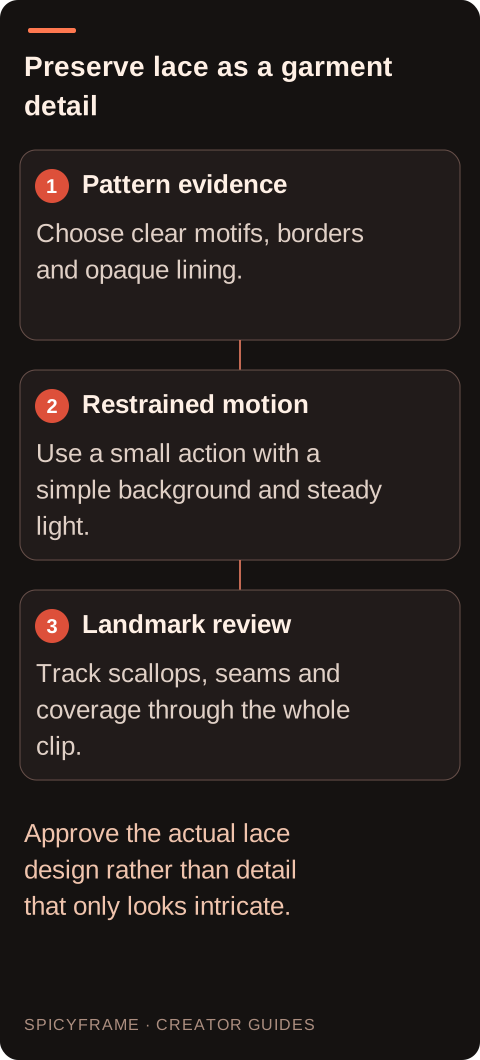
Pick a few landmarks that can be tracked: a scalloped neckline, a floral motif near a seam, a cuff border, or a repeated band across the skirt. You do not need to count every tiny opening, but you should know what makes the design recognizable. Record which elements are symmetrical and which are intentionally different. If the garment has a decorative panel, note its boundary against the plain fabric. These landmarks create a practical review method when the pattern becomes too complex to inspect stitch by stitch. Avoid promising exact reproduction of a copyrighted textile design unless the rights and output accuracy are established. A generated approximation can be appropriate for a mood concept, but a product listing should not silently substitute a new lace pattern for the one being sold.
A second image can clarify the same garment's cuff, neckline, or back panel, provided it shows the same lace design and lining. Do not combine several attractive lace garments and expect the output to preserve one specific item. Conflicting motifs can lead to an invented hybrid whose surface looks detailed but is commercially inaccurate. The multiple-reference guide explains how each reference should resolve a particular ambiguity. SpicyFrame supports up to 12 authorized JPG, PNG, or WebP images under 10 MB each, but there is no requirement to use the maximum. Keep the primary image visually dominant in your own brief and describe the role of any additional view. More detail is helpful only when it remains consistent with the approved garment.
Soft directional light can reveal the raised pattern while keeping the lining and overall silhouette readable. Very hard light can create dense small shadows that compete with the motif, while flat lighting may make lace look printed rather than layered. The lighting guide helps describe a clear source direction and contrast level. Choose a simple background whose tone separates the garment edge. Avoid patterned walls, sparkling accessories, and moving light effects in the first test, because they create competing fine detail. If the design is dark lace over dark lining, preserve enough tonal separation to see the motif without exaggerating transparency. The lighting should help a viewer understand the clothing construction, not transform the visual purpose into exposure or an erotic presentation.
Start with a gentle turn, small posture adjustment, or slow camera approach. Fine lace detail can become unstable when the garment deforms rapidly or moves across the frame at high speed. Keep arms from repeatedly covering and uncovering a patterned panel if that panel is the main product feature. A short, calm clip may show the design more effectively than an energetic sequence. This is a practical test strategy, not a claim that a particular motion always succeeds. Inspect the pattern during the movement, not only when the subject pauses. If the motif collapses during a turn, reduce the angle or choose a source with clearer construction. Do not compensate by requesting more intricate lace, since additional complexity can make the original continuity problem harder to isolate.
Pause at several points and compare the selected landmarks. Look for flowers changing shape, scallops multiplying, borders drifting away from seams, and lining that becomes transparent. Also watch at normal speed for crawling texture that is difficult to see in isolated frames. The artifact guide can help determine whether the source, movement, or overlapping objects caused the issue. Check fingers and jewelry near the lace because fine shapes can merge. Higher resolution may reveal more pattern detail, but it does not guarantee stability. SpicyFrame offers vertical 9:16 MP4 at 480p, 720p, or 1080p in 5-, 10-, or 30-second durations. Review the final selected quality independently, since a new generation can differ from a previously approved draft.
Decide whether the final clip is a styling concept or an advertisement for a specific garment. A concept can tolerate an original decorative pattern if it is honestly presented, while a catalog item needs closer comparison with the real design. Obtain brand approval for motif, lining, color, and silhouette before publishing a product claim. SpicyFrame uses Seedance 2.5 through Segmind, supplies ambient audio, and does not include a timeline editor or 4K output. Add accurate text and licensed sound through your editing workflow. Keep the adult subject's permission and source licenses with the final file. If a completed render changes the lace, that is not automatically a confirmed generation failure; budget design revisions separately from technical failure handling. Approve the clip only when the pattern and coverage serve the intended fashion purpose.
| Landmark | Reference evidence | Reject or revise when |
|---|---|---|
| Motif | Clear repeated shape and scale | Flowers or geometry change identity |
| Scalloped edge | Defined border at neckline or cuff | Scallops multiply or detach |
| Panel boundary | Visible seam against plain fabric | Lace spreads beyond the approved area |
| Opaque lining | Stable coverage under the decorative layer | Transparency appears during movement |
| Nearby objects | Separate fingers, jewelry and garment edges | Fine shapes merge into the pattern |
It contains many small repeated shapes that can change or crawl across frames. Use stable landmarks such as borders and motifs to review continuity rather than judging overall detail alone.
For the non-erotic fashion workflow here, use opaque lining or otherwise appropriate coverage. Review that coverage throughout the video so generated texture does not become accidental transparency.
Only if an invented design is actually the goal. For a specific garment, use consistent views of the same motif and construction; mixed references can produce a misleading hybrid.
Try soft directional light with enough separation between lace, lining, and background. Avoid extreme contrast or competing patterned surroundings that make the garment's fine details harder to read.
Check scalloped edges, seam alignment, cuffs, lining opacity, and nearby fingers or jewelry. Fine shapes can merge even when the overall garment silhouette remains stable.
Only after appropriate accuracy review. Have the brand verify pattern, lining, color, and construction, and do not silently replace the real textile design with a generated approximation.