5 seconds · 480p · $3.99. Pay per video, no subscription required.
Updated
AI-generated editorial illustration: a red satin evening look and warm lounge lighting. The photograph illustrates a fashion brief, not a tested video output.
Private can mean several different things
“Are Grok Imagine videos private?” is not answered fully by whether a clip appears on your public profile. Public visibility, access through a shared link, provider processing, use for training and retention are separate questions. The official source reviewed here is X Help's About Grok page, which describes Grok on X. Do not automatically apply those details to a standalone Grok product or every image and video workflow. For non-explicit adult glamour, decide what level of confidentiality the source requires before uploading it. The broader Grok spicy guide supplies product context, but a style label does not define privacy. The exact service surface and its current controls are what matter.
Identify the surface and read its applicable policy
Record whether you are using Grok within X, another official Grok experience or a separate integration. Find the privacy information that explicitly applies to that route. A general article can explain concepts but should not replace the current policy and settings for a sensitive project. Check what is said about inputs, outputs, account information, service providers and retention. If a question is not answered, keep it unresolved rather than filling the gap with an optimistic assumption. The X Help page itself advises users not to share sensitive or confidential information in Grok conversations. That advice is relevant when deciding whether an unpublished adult glamour portrait belongs in a hosted workflow at all.
Separate public sharing from service processing
A file that is not publicly posted can still be processed by the provider to perform the requested task. Conversely, a shared link or published post can make an output accessible beyond the original session. Inspect the actual sharing action before using it, and do not assume that “copy link” means a private transfer. Check the intended audience and avoid placing private reference images in public posts as a convenient way to move them between devices. Keep a local authorized copy for production work. The general video privacy guide explains the same conceptual separation for SpicyFrame, but its product-specific settings should not be transferred to Grok. Each service needs its own evidence.
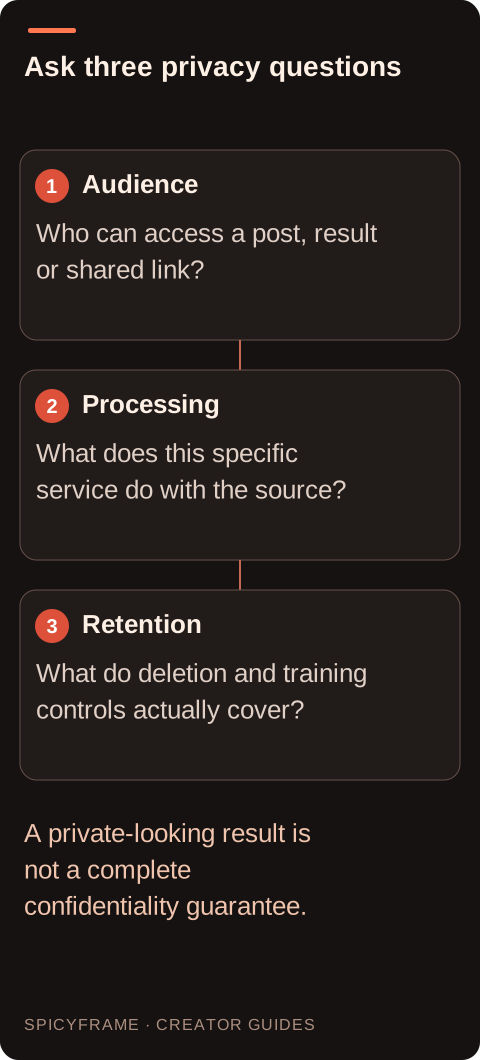
Audience: Who can access a post, result or shared link?. Processing: What does this specific service do with the source?. Retention: What do deletion and training controls actually cover?. A private-looking result is not a complete confidentiality guarantee.
Understand the training and personalization controls described for X
X Help states that public X data and interactions, inputs and results with Grok on X may be shared with xAI for training and improvement. It describes controls for training and fine-tuning and a separate control for personalization. These are different settings, so turning off one should not be described as switching off every possible use of data. The help page also notes that voluntarily submitting feedback can allow the associated conversation data to be used for training even after opting out. Read the current wording and controls in your account before relying on them. This is a summary of the documented X context, not a claim that every Grok product has identical menus or treatment of generated media.
Treat deletion and immediate disappearance as different events
The X Help page says deleted Grok conversation history is removed from its systems within 30 days unless retained for security or legal reasons. That statement does not mean an item vanishes from every system immediately when it disappears from your view. Nor does it establish the retention rules for every separate media workflow or third-party copy. If an output has already been downloaded or shared with someone else, deleting the original conversation does not necessarily recall those copies. Decide what you need before submitting the source. If the project requires a confidentiality guarantee that the documented workflow cannot establish, use a different production method rather than assuming later deletion will solve the mismatch.
A hypothetical privacy review for an unreleased campaign
Suppose an adult fashion model and photographer are preparing an unreleased eveningwear campaign under a confidentiality agreement. Before using Grok, the team identifies the exact product surface, checks its applicable privacy terms, reviews training and sharing settings, and confirms that the agreement permits hosted AI processing. They remove unnecessary personal details from the working image and avoid public sharing. This is a proposed review process, not a claim that the workflow satisfies every contract. If the confidentiality requirement remains incompatible or unclear, they do not upload the source while hoping a private-looking interface will be sufficient. A suitable tool must fit the actual agreement, not merely produce an attractive glamour scene.
Compare another service without treating less storage as no processing
SpicyFrame offers a setting controlling whether new photos and video persist in the library and browser draft. Turning that storage off does not prevent generation-provider processing or payment processing needed to deliver an order. Guest purchase also does not establish anonymity. These are SpicyFrame-specific distinctions, not Grok settings. The guest workflow guide explains the separate access model. If comparing services for an adult glamour project, use the same questions for each: who can see the output, what is processed, what may be retained, what training choices exist and what the contract permits. Do not rank privacy from a single switch or the absence of a signup form.
Keep a record of the decision and share deliberately
Save the relevant policy date, chosen settings and permission to process the source with the project record. Review sharing controls again when exporting or sending the final clip; privacy decisions made before generation can be undone by a careless publication step. Remove unneeded personal information from captions and filenames, and send only the asset intended for the recipient. If a privacy question remains unresolved, ask the provider through an official channel rather than assuming a community answer applies universally. The photographer guide provides broader client-work context. A careful privacy decision is specific to the source, service and intended audience, and acknowledges the limits of what the available documentation actually guarantees.
Practical decisions for this brief
Requirement
Decision
Evidence to check
Result is not publicly posted
Check processing separately
Private visibility is not equated with no service access
Training preference matters
Review the applicable account control
Product surface and setting scope are clear
Personalization is unwanted
Check its separate control
Training and personalization are distinguished
History is deleted
Read the documented retention caveat
Immediate universal deletion is not assumed
Campaign is confidential
Review the actual agreement before upload
Hosted processing is permitted by the project terms
AI image-to-video questions answered
Does an unpublished Grok result mean no provider processing?
No. Public visibility and processing are separate questions. Check the policy for the exact product surface rather than assuming a private-looking interface means the provider cannot process the material.
Do the cited X privacy controls apply to every Grok app?
Do not assume so. The official source reviewed describes Grok on X. Standalone products and separate media workflows need their own applicable documentation and settings checks.
Are training and personalization the same setting?
X Help describes them separately. Review both where relevant, and read the current explanation rather than treating one opt-out as a universal switch for all data handling.
Can feedback affect training even after opting out?
The X Help page says voluntarily submitted feedback can allow the associated conversation data to be used for training. Check the current wording before sending sensitive material with feedback.
Does deleting history remove everything immediately?
The cited X Help page gives a removal period of up to 30 days with security or legal exceptions. That is not an immediate universal deletion guarantee or a recall of shared copies.
Does SpicyFrame storage-off mean no AI provider sees the source?
No. It removes library and browser draft persistence for new material, while provider processing still occurs to deliver the video. That setting should not be confused with local-only generation.
Sources
External pages, opened in a new tab. Rankings reflect the time of writing.