Should I put NSFW or spicy in every prompt?
Those labels do not define a scene. Concrete adult fashion details, lighting, framing and one action are more useful for communicating a non-explicit glamour brief.
SPICYFRAME · PRACTICAL GUIDES
Write non-explicit NSFW-style prompts for adult glamour video using concrete wardrobe, one readable action, stable lighting and a realistic review method.
5 seconds · 480p · $3.99. Pay per video, no subscription required.
Updated

NSFW AI prompts are more useful when they describe an actual non-explicit adult glamour scene than when they repeat a broad label. “Spicy” does not tell a generator where the camera is, what the subject wears or which part of the image should move. Start with a clearly adult person or fictional adult character, an authorized reference where relevant, a specific outfit and one mood expressed through light or posture. A velvet evening jacket under warm club lighting is concrete; “make it more intense” leaves the visual meaning open. This guide focuses on fashion and cinematic atmosphere. It does not provide sexual prompts or techniques for avoiding a provider's content rules.
Name the outfit as something to preserve, not as an invitation to transform it. “Adult model in the same burgundy evening dress” establishes continuity more clearly than a string of unrelated style words. If a garment feature matters, identify the visible detail: structured shoulders, a long coat hem or a satin lapel. Avoid demanding exact unseen construction from a single front view. Keep the clothing description consistent across references and prompt text. The fashion video guide explains why stable garment shape matters across time. A clear wardrobe sentence also makes review easier: you can compare the requested silhouette with the opening, middle and final parts of the clip rather than judging only its mood.
A short scene benefits from a primary action with a clear beginning and end. Examples include a subtle glance toward the lens, one gentle change of posture or a small movement in a coat hem. Avoid combining a walk, turn, hand gesture, smile and camera orbit unless the sequence truly requires that complexity and you accept its uncertainty. Describe the scale of movement, not only its name. “A slight turn while the face remains visible” sets a different brief from “turn around.” The camera movement guide helps separate subject motion from camera motion. If both move, explain which one should carry the viewer's attention so the shot does not become a competition between effects.
Glamour lighting can be bold while remaining coherent. Specify a soft key light from one side, a restrained red background glow or a subtle rim light on the jacket. Avoid mixing incompatible instructions such as harsh noon sun, candlelight and a dark nightclub in one ordinary room. Name what should remain steady if continuity matters. A light that appears to travel around the face changes the perceived shape and may look like identity drift. The lighting prompt guide gives a broader vocabulary, but a compact prompt usually needs only the main source and the intended atmosphere. More adjectives do not automatically produce more control; conflicting adjectives can make the scene less definite.
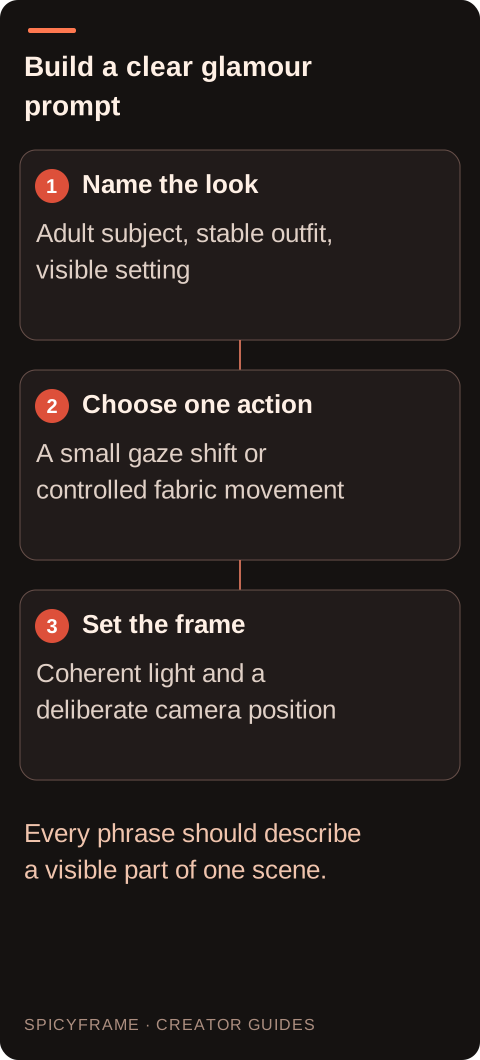
A practical order is subject and wardrobe, action, setting and light, then framing. For example: “Clearly adult fashion model in the reference velvet jacket, one gentle glance toward the lens, quiet evening studio with soft amber side light and a restrained red backdrop, still vertical medium portrait.” This is a proposed non-explicit prompt, not a tested result. It makes each clause serve a different purpose and avoids adding unsupported technical controls. SpicyFrame does not provide seed, negative-prompt, mask or endpoint controls for this workflow. Put ordinary scene instructions in the available prompt field and understand that they are guidance, not guarantees that every region or frame will remain fixed. The free NSFW prompt generator builds a structured, non-explicit prompt from menus, with subject, action, camera, light and mood.
A close face crop supports different movement from a full length fashion photograph. If the hands are absent, do not make a detailed hand gesture the central action. If the garment touches the edge, avoid a wide sideways movement. If the background is already busy, a steady camera can preserve readability better than a dramatic orbit. Use up to 12 authorized JPG, PNG or WebP references under 10 MB each only when the additional views clarify the same scene. The multiple reference guide explains reference roles. Prompt-only generation is possible, but it changes the task from animating visible evidence to establishing the adult character, outfit and setting through text alone.
Imagine a proposed clip of an adult in a satin evening dress whose first result, hypothetically, changes the neckline during a broad turn. A useful revision would narrow the turn, keep the camera still and state that the visible dress silhouette remains consistent. It would not add five new style adjectives or request a different location at the same time. If the source itself barely shows the neckline, a clearer reference may be more useful than stronger wording. This is a diagnostic example, not a report of a test. The artifact guide supports the same principle: identify the failure mode, then change the smallest part of the brief that plausibly caused it.
Before generation, define two or three acceptance criteria: recognizable adult subject, stable outfit and one readable action, for example. Afterward, watch at normal speed and inspect key frames. Check whether an unwanted zoom changes the crop, whether jewelry appears or disappears, and whether the lighting remains coherent. Do not treat a beautiful still as proof that the full motion works. SpicyFrame delivers a single vertical 9:16 MP4 with ambient sound in 5, 10 or 30 seconds. Exact captions, scripted voice and precise editorial timing require separate planning and external finishing where appropriate. A good prompt narrows the creative task; it does not turn a generative video workflow into a fully deterministic editing system.
| Requirement | Decision | Evidence to check |
|---|---|---|
| Prompt is only a mood label | Name wardrobe, light and action | The scene can be pictured without guessing |
| Several actions compete | Select one primary movement | Beginning and end are readable |
| Outfit changes during a turn | Reduce the turn and clarify the look | Visible garment shape remains coherent |
| Camera and subject both drift | Assign the main movement explicitly | Framing supports the intended attention |
| Source omits the hands | Avoid a hand-led performance | The brief uses visible evidence |
Those labels do not define a scene. Concrete adult fashion details, lighting, framing and one action are more useful for communicating a non-explicit glamour brief.
Describe the adult subject and outfit, then one action, the setting and light, and finally the framing. Keep each clause consistent with the source image and the others.
This workflow does not provide those dedicated controls. Use ordinary scene wording in the prompt field and do not assume instructions can lock regions or guarantee identical results.
Start with one main action that is readable in the chosen framing. Additional gestures and camera changes create more relationships to maintain and more possible sources of drift.
Check source clarity, reduce the movement that exposes unseen construction and preserve a coherent wardrobe description. Change one meaningful variable rather than rewriting the whole scene at once.
No. Clear references and restrained movement can make the brief better defined, but likeness and temporal consistency still need review throughout the generated sequence.