Must every adult glamour prompt be written in English?
Do not assume a universal requirement or advantage without documented support. Use clear wording whose meaning you can verify against the reference.
SPICYFRAME · PRACTICAL GUIDES
Write clear permitted adult glamour prompts across languages by defining the subject, outfit, action and light without ambiguity or moderation evasion.
5 seconds · 480p · $3.99. Pay per video, no subscription required.
Updated

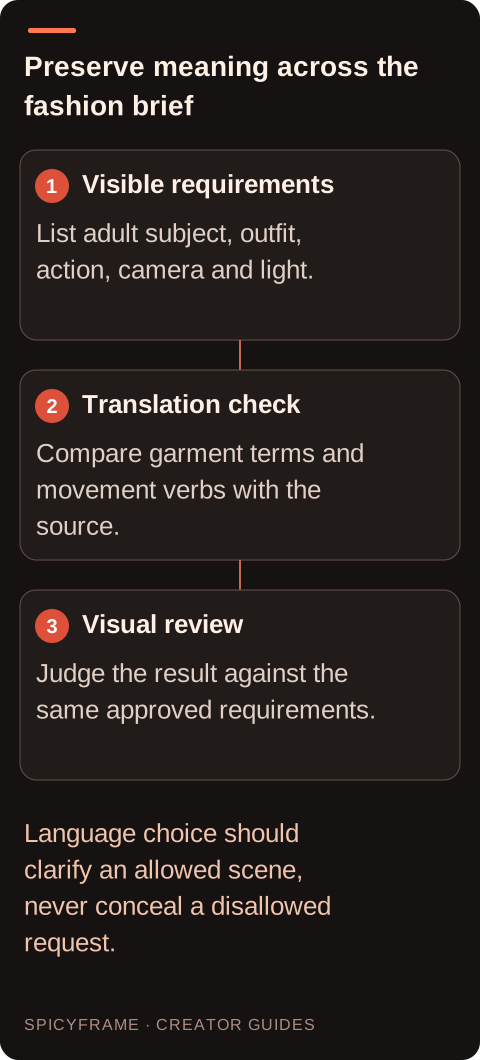
An NSFW AI prompts English search may reflect uncertainty about whether a fashion brief needs English to work. The useful goal is a clear description of an authorized adult scene, not a belief that one language unlocks different content. SpicyFrame's permitted adult glamour workflow remains non-explicit regardless of the words or language used. Do not translate or disguise a refused request to evade moderation. Describe the adult subject, approved outfit, one visible action, camera intention and light in terms you can verify afterward. If the studio or model does not document a particular language guarantee, avoid claiming one. A concise, understandable brief is more useful than a long translated paragraph whose fashion terms you cannot confidently review.
Write the scene first in plain language: an adult in an evening jacket makes a slight turn under soft red side light. Then add a small amount of mood if it changes the visible result. Words such as glamorous, dramatic or cinematic are broad; they do not specify which garment, pose or camera move matters. The prompt examples guide provides a general structure, while the glamour prompt guide offers stylistic context. Keep the brief non-explicit and avoid ambiguous body-focused language. The more concrete the description, the easier it is to compare the result with the intention and identify whether the problem concerns clothing, motion, light or interpretation.
Fashion vocabulary can shift meaning between languages. A word for a jacket cut, a fabric finish or a particular collar may not have a simple one-word equivalent. Describe the visible feature when a label is uncertain: a short structured jacket with wide lapels, or a long coat with a straight hem. Keep the authorized reference available while reviewing any translation. Do not let an automated rewrite turn a fully clothed adult portrait into a different styling concept. If exact garment construction matters, the image and clear role description remain essential evidence. A translation should preserve what the project has approved, not add imagined accessories, exposure, poses or commercial claims simply to make the sentence sound more elaborate.
When multiple images are used, state which one defines the adult identity and which supplies the outfit or setting. Avoid pronouns that could refer to several people or objects. A sentence such as “the adult model in the lead reference keeps the approved jacket and makes a small shoulder turn” gives a clearer subject than a chain of “they,” “it” and “that one.” The multiple-reference guide explains role assignment. Choose one primary action verb and one camera intention. If a translation adds both a turn and an orbit, check whether those were actually intended. SpicyFrame has no seed or exact motion-path control, so even a clear brief expresses a direction rather than a guaranteed repeatable sequence.
Color words and lighting metaphors can carry different associations. “Soft red side light with a dark neutral backdrop” is more inspectable than a phrase whose meaning depends on a cultural reference or an unfamiliar genre label. Identify whether light should remain steady, which side it comes from and what it helps reveal about the outfit. The lighting guide gives useful vocabulary for these choices. Do not pile contradictory cues such as daylight, nightclub strobes and candlelight into one simple portrait unless the scene truly requires them. If the goal is a calm adult fashion image, one coherent lighting environment gives the reviewer a clearer standard for skin tone, garment texture and unwanted brightness changes.
Imagine a creative brief written in French for an authorized adult model wearing a velvet evening jacket. The intended action is a slight shoulder turn, with a steady medium portrait and soft window light. Before translating, list those four visible requirements separately. Review the English version against the photograph and remove a translation that accidentally changes velvet to satin or turns a small glance into a full rotation. A permitted final direction might read: “The adult model in the velvet jacket makes a slight shoulder turn, steady medium portrait, soft window light and quiet room ambience.” This hypothetical example is not a tested language comparison. It illustrates meaning preservation, not a claim that English guarantees a better result.
If the result is wrong, identify the visible mismatch before blaming translation. A jacket changing shape may be a continuity problem; a different camera move may reflect conflicting wording; an altered face may relate to source evidence or the requested angle. Compare the brief with the reference and revise one meaningful ambiguity. Separate generations can vary, so one better result in another language does not prove a universal language advantage. Keep notes about the actual wording and the observed change. If a request is refused, follow the stated rules and choose a genuinely permitted concept where appropriate rather than testing coded synonyms. Language review should improve communication of an allowed scene, not conceal what the request is asking for. Use a back-check focused on visible meaning when reviewing a translated brief. Ask a reviewer to explain what the adult does, what clothing remains on screen and how the viewpoint changes without showing them the original sentence. Compare that explanation with the approved source concept. If they describe a different garment or a larger movement, simplify the ambiguous phrase before generation. This is often more useful than debating whether a translation sounds elegant. Keep proper names, product labels and exact claims outside the visual-generation prompt when they will be added as readable external text; those elements need their own copy check. For multilingual teams, record which description is the approved source of meaning and which versions are working translations. A later editor should not infer permission for a new pose or representation merely because one translated adjective sounds broader. The goal is a consistent allowed fashion scene across the team, with enough shared vocabulary to diagnose the result. Clarity can reduce avoidable misunderstanding, but it cannot establish identical model behavior across languages or remove the need to inspect every generated clip.
For a recurring adult fashion project, save a short list of approved garment descriptions, camera terms, light phrases and reference-role wording in the languages the team uses. Include the actual visual meaning, not just a word-for-word translation. Reuse that vocabulary when it still matches the new source, but update it when the outfit or scene changes. Have a person who understands the intended representation review important translations where practical. Keep the final prompt with the approved clip so later variants can be compared accurately. The acceptance standard stays visual and concrete: the authorized adult, intact outfit, clear action and coherent light match the brief. A polished sentence is useful only when it preserves that meaning.
| Situation | Action | Verify |
|---|---|---|
| Garment term has no clear translation | Describe visible construction and fabric | The approved outfit meaning is preserved |
| Brief mixes several action verbs | Choose one primary movement | The adult pose remains understandable |
| Reference roles are ambiguous | Name identity, outfit and setting roles | Each image has one clear purpose |
| Translation adds a dramatic camera move | Remove the unintended change | The viewpoint matches the original brief |
| Request has been refused | Review requirements and permitted alternatives | No coded language or translation-based evasion |
Do not assume a universal requirement or advantage without documented support. Use clear wording whose meaning you can verify against the reference.
No. Do not translate, code or disguise a disallowed request to evade moderation; choose a genuinely permitted concept instead.
Garment construction, fabric, action verbs, camera movement and reference roles, because small wording changes can alter the intended scene.
Not necessarily. Extra mood language can obscure the subject, outfit and action that the generated clip actually needs to show.
Preserve the intended meaning and review visible outcomes, while recognizing that separate generations vary and do not prove a universal language effect.
Approved garment terms, simple actions, camera descriptions, lighting phrases and their concrete visual meanings in the languages used.