Does a late cuff change make the entire clip unusable?
Not necessarily. Identify whether an earlier coherent interval completes the fashion message and whether the project allows an external trim.
SPICYFRAME · PRACTICAL GUIDES
Review a completed 30-second adult glamour clip for late outfit drift, repeated gestures and usable cut points before choosing an edit or retry.
5 seconds · 480p · $3.99. Pay per video, no subscription required.
Updated

A thirty-second adult glamour clip can begin convincingly and still fail near the end. A cuff length changes after a turn, a brooch disappears, or the model repeats an already completed gesture. Start with the downloaded result and identify the first moment the approved fashion idea stops working. Keep the authorized adult likeness and intact, non-explicit outfit as the review standard. This guide diagnoses a completed long take; the thirty-second creation guide covers the ordinary generation workflow and duration choice. Do not assume a late defect means the entire clip is unusable, or that a longer prompt will repair it. First determine whether the problem is pacing, garment continuity, framing or a combination that requires a different shot.
Watch the clip once without pausing, then note the start of each visible pose change and any repeated action. At those moments, compare a small set of garment landmarks: collar, cuff, closure and hem. Record the last clearly acceptable moment and the first questionable one. Use actual timestamps from the file rather than assuming every thirty-second scene has the same three phases. A simple record might say that the first turn completes, the pose settles, and the next turn coincides with a changed sleeve. Those observations distinguish an editorial repetition from a structural defect. The storyboard guide helps assess whether the repeated action serves the story, while the timeline notes establish what the existing result actually contains.
Compare the affected clothing feature with the authorized source. A large turn may reveal a sleeve or back panel that was not visible earlier, whereas gradual drift changes a feature that has remained in view. Neither observation proves an internal cause, but the distinction guides the next experiment. If the source never shows the required angle clearly, seek an approved view that does. If a clearly visible collar slowly changes shape while the adult holds a similar pose, shortening or simplifying the take may be more relevant. The fashion guide supplies broader styling context. Keep the review focused on the exact garment feature rather than judging late frames only by whether they remain generally attractive.
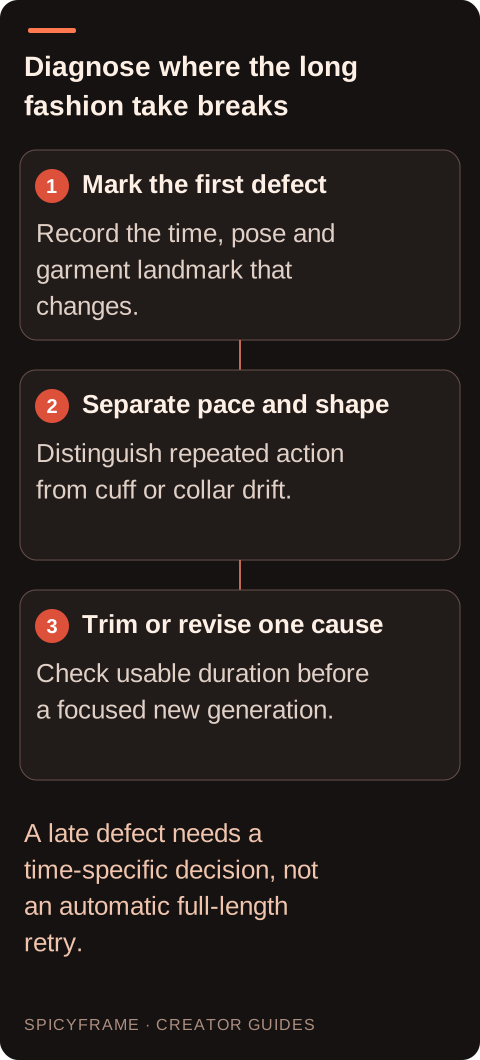
A second shoulder turn can feel redundant even when the jacket remains coherent. A changing cuff can be unacceptable even during otherwise useful movement. Mark those as separate problems in the review record. If the first gesture already completes the message, an external trim may solve the pacing issue. If essential fashion information occurs only during the later defective passage, trimming may remove the purpose of the clip. SpicyFrame has no built-in timeline; any cut or sequence assembly happens in a separate editor. The duration guide gives general pacing context, but the decision here comes from the actual usable action and the project requirement, not from a rule that all thirty seconds must always be retained.
If another generation is justified, select the smallest meaningful revision supported by the review. A cuff changing after a large turn suggests testing a smaller turn or a clearer angle reference. An intact outfit followed by repeated gestures suggests a simpler action with a longer resting state. A camera approach that crops the hem suggests more comfortable framing. Do not change reference, lighting, resolution and action simultaneously if the goal is learning which practical adjustment helps. Separate generations still vary, and the studio has no seed control for an identical experiment. Keep the approved adult fashion brief non-explicit and concise. Record the proposed change next to the original failure time so the new result can be checked against a specific observable problem.
Imagine an authorized adult evening-coat clip that looks coherent for the first ten seconds, repeats the same shoulder turn in the middle and develops a changing cuff near the end. Review each issue separately. The repeated action is a pacing problem; the cuff is clothing continuity. A shorter external trim may preserve a complete, useful fashion moment if the beginning already communicates the brief. If the sustained duration is essential, simplify the planned action and seek a clearer source for the sleeve before another purchase. This hypothetical example is not a tested render or proof of an internal cause. It shows why a long clip should be evaluated as a complete sequence, not approved from its strongest opening frame.
Watch the full result normally, then inspect the opening, each change of pose, the midpoint and the ending. Compare the face, collar, sleeve length, jewelry and background landmarks. Long scenes can drift gradually, so place an early and late frame side by side where useful. Listen for unexpected sound changes as well as visual ones. A generated room ambience may suit the scene without providing the exact rhythm a music-led fashion edit requires. Any soundtrack replacement or trimming happens in a separate editor; SpicyFrame has no built-in timeline. Keep the original MP4 and review the final export after editing, because a useful trim can still create an abrupt audio ending or cut before the pose has settled. Review the sustained scene with a simple attention map. Note where the viewer first understands the outfit, where the main action becomes clear and where the movement finishes providing new information. If understanding is complete very early, the remaining time must earn its place through atmosphere or a deliberate held composition. Do not confuse a repeated gesture with meaningful development. A second identical shoulder turn can feel like a loop even when the file is one continuous generation. Conversely, a quiet pause can be useful if the collar, face and fabric remain compelling and coherent. Discuss the intended viewing context with the creative reviewer: a background installation can tolerate a different rhythm from a short promotional introduction. This is an editorial distinction, not a platform timing rule. Record the first moment at which the clip feels finished, then compare that judgment with the required delivery length. When the two disagree, solve the story or external edit rather than inventing extra adult movement to occupy the unused seconds. The strongest long fashion scene usually has fewer essential actions than its length initially suggests.
The selected generation length does not oblige the final audience to watch every second. If the strongest version is a clean twelve-second excerpt, use it when the project allows and label it as an edited result. If an exact thirty-second deliverable is required, plan that requirement before ordering rather than stretching a weak ending afterward. A separate editor can assemble or hold material, but those are external creative choices and should not be mistaken for native continuous action. Define success through the approved adult likeness, intact outfit, coherent pacing and comfortable final frame. Keep notes about where the original began to repeat or drift so the next concept can address the actual weakness instead of simply requesting more movement.
| Situation | Action | Verify |
|---|---|---|
| Action repeats but outfit remains stable | Find the earliest complete editorial ending | A shorter version still communicates the idea |
| Cuff changes only after a large turn | Inspect source angle and reduce the turn | The cuff survives the same action |
| Collar drifts while pose stays similar | Compare earlier and later landmark frames | Gradual change is distinguished from reveal |
| Important action occurs after the defect | Revise the shot or plan another sequence | The required fashion information remains accurate |
| Exact thirty-second delivery is required | Evaluate a full-duration solution | External edits satisfy the actual brief |
Not necessarily. Identify whether an earlier coherent interval completes the fashion message and whether the project allows an external trim.
Track action timing and garment landmarks independently. A repeated turn is a pacing issue; a changed cuff is a continuity issue.
Note pose-change times, the last acceptable moment, the first visible defect and the collar, cuff, closure or hem affected.
There is no built-in timeline or local garment repair. Trim, assemble or attempt a repair in a separate editor.
Plan a valid full-length solution; do not hide an essential defect or imply a shortened clip still satisfies that requirement.
Only when detail is the actual issue. Resolution does not guarantee a correction for repeated motion or late garment changes.